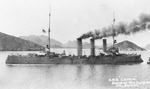
SMS Leipzig at Guaymas, 1914
|
|
SMS Leipzig was a Breman class light cruiser built for the German navy in 1905-6. At the outbreak of the First World War the Leipzig was stationed off the Pacific coast of Mexico. In October 1914 she joined the East Asian Squadron of Admiral von Spee at Easter Island.
Von Spee had decided to take his squadron into the south Atlantic. The commander of the British South American squadron, Admiral Cradock, decided to intercept von Spee in the Pacific, and led his force of three cruisers into the Pacific. At Coronel (1 November 1914), von Spee ambushed the British, sinking Cradock’s two biggest cruisers. Only HMS Glasgow escaped.
After his victory at Coronel, von Spee took his squadron into the Atlantic. Once there he made a serious error and attacked the British coaling station on the Falkland Islands. There he ran into the British squadron assembled to hunt him down. While his largest ships, the Scharnhorst and Gneisenau, attempted to hold off the British battlecruisers Invincible and Inflexible, the lighter cruisers attempted to escape. The Leipzig was chased down and sunk by HMS Cornwall and HMS Glasgow. While the Leipzig might have had a chance against the Glasgow, armed with two 6in and ten 4in guns, the Cornwall carried fourteen quick firing 6in guns. The two British cruisers seriously outgunned the German ship, whose armament had not been designed to fight other cruisers.
Displacement (loaded) |
3,756t |
Top Speed |
23kts |
Length |
364ft 9in |
Armaments |
Ten 105mm (4.1in) guns |
Crew complement |
288 |
Launched |
21 March 1905 |
Completed |
20 April 1906 |
Sunk |
8 December 1914 |
 German Commerce Raiders 1914-18, Ryan K. Noppen.
Looks at the surface vessels that operated against Allied shipping during the First World War, a mix of warships, converted liners and converted freighters, including one fully masted sailing ship. Although nowhere near as successful as the later U-boat campaign, these surface ships did embarrass the Royal Navy, especially early in the war, and forced the diversion of sizeable RN and Allied naval forces, so they are well worth studying [read full review]
German Commerce Raiders 1914-18, Ryan K. Noppen.
Looks at the surface vessels that operated against Allied shipping during the First World War, a mix of warships, converted liners and converted freighters, including one fully masted sailing ship. Although nowhere near as successful as the later U-boat campaign, these surface ships did embarrass the Royal Navy, especially early in the war, and forced the diversion of sizeable RN and Allied naval forces, so they are well worth studying [read full review]