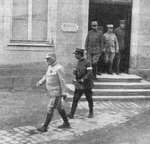
Robert Georges Nivelle (1856-1924), French General
Born to a French father and English mother, Nivelle rose from Artillery Sub-lieutenant in 1878 to Colonel of Artillery in December 1913. Before the First World War he served with distinction in Algeria, Tunisia and China. He was a gifted Artilleryman, and the intense fire he was able to maintain played a key part in stopping German attacks during the Alsace Offensive early in the war, the first battle of the Marne (5-10 September 1914) and the first battle of the Aisne (15-18 September 1914), after which he was promoted to General (October 1914). He played a key part in the battle of Verdun (21 February-18 December 1916), as one of General Petain's subordinates, and played a key part in the planning of successfull, if limited, French counterattacks towards the end of the battle. This played a key part in his promotion to Commander in chief of the French armies on 12 December 1916, replacing Joffre. He was a good talker, and won over Lloyd George to his grand plan to win the war in 1917.
This involved a British attack in the north to draw in German reserves, followed by a massive general French attack, aimed at the Arras-Soissons-Reims salient. Secrecy was soon lost. Nivelle was willing to talk about his plan to anyone who asked, including journalists, while the Germans captured copies of the battle plan left in the French trenches. To make things worse, at the start of 1917 the Germans withdrew to a new fortified line, the Hindenburg line, prepared with great care and expense. The British attack came first (Battle of Arras, 9-15 April 1917), followed by the great French assault (Second battle of Aisne, 16 April- 1917). The morale of the French troops was boosted by the arrival of American troops, the appearance of increasing numbers of Tanks, and most of all by Nivelle's boasts of success. Within hours of the start of the battle, the French ground to a halt, but Nivelle kept on attacking, despite promises not to continue if the results were not good. In alarm, the French government replaced him by General Petain on 15 May 1917. He was shuffled off to the African war in December 1917, from where he returned after the war was over, before retiring in 1921. Despite the failure of his great plan, his insistence on the further development of the tank produced results in 1918.
 Breaking Point of the French Army - The Nivelle Offensive of 1917, David Murphy
.
Looks at the state of the French army at the start of 1917, the hopes raised by Nivelle when he took command, the failure of his offensive and the crisis of morale caused by that failure. Includes interesting material on how Nivelle and his team were able to ignore the evidence that there were problems with their plan, and on how Petain managed to undo the damage to the French army in remarkably little time
(Read Full Review)
How to cite this article: Rickard, J. (20 February 2001), Robert Georges Nivelle (1856-1924), French General, https://www.historyofwar.org/articles/people_nivelle.html