 |
|
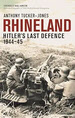


The Rhineland campaign was the last coherent German defensive campaign in the west. It started with an attempt to keep the Allies away from the Rhine, before turning into a battle for the river itself. Once the Rhine was crossed the German defences collapsed, and the western Allies were able to advance at great speed for the remaining six weeks of the war. This book looks at those two campaigns, with the main focus being on the German point of view. This is what makes this book unusual – most accounts of this fighting tend to focus on either Montgomery in the north or Patton in the south, so to see the German view is very valuable. The author has found many German eyewitness accounts at every level from private soldiers to the army commanders (in particular Kesselring, who was parachuted in from Italy just in time to face total defeat). One interesting feature of these accounts is how different commanders reacted to the certainty of defeat. Some were simply concerned with keeping their commands as intact as possible before the inevitable surrender, others became obsessed with ‘what if’s’ – in particular what if the troops lost in the Ardennes had instead been kept back to act as an armoured reserve for the defence of the Rhine (forgetting that the ‘best’ case scenario might have seen the Western Allies slowed down enough for the Soviets to occupy most of western Germany and Denmark).
This book is an interesting addition to the debate on the broad front vs narrow front controversy. After the war some of the German commanders felt that the Allies would have been better off focusing on a single strong narrow thrust across northern Germany towards Berlin. However those views tend not to take into account the supply problems faced by the Allies (and tie into a problem often seen with German plans during the war, which failed to take into account the importance of logistics). One also wonders if this view is partly because they would have preferred the Western allies to conquer Berlin instead of the Soviets. However an examination of the campaign itself suggests that Eisenhower’s broad front strategy had much going for it. The Germans were the masters of the strong counter-attack, with a defensive doctrine that relied on rapidly concentrating forces against any breakthrough and hitting it hard. However in the Rhineland and along the Rhine every part of the German army was under pressure at the same time, so there were no reserves available to be moved to deal with a breakthrough, and with crisis erupting along widely separated parts of the front almost at the same time it would have been hard to know where to move those reserves anyway. On the few occasions where troops were moved to deal with a crisis – at Remagen for instance – it just left a different part of the line vulnerable to attack. A single strong thrust might have been able disrupt the German defences, but it might also have bogged down and turned into a much larger version of Operation Market-Garden.
We see a big difference between the American and British approaches to crossing the Rhine, with the Americans ‘bouncing’ the Rhine, taking advantage of their momentum (and luck) to get footholds on the east bank, while Montgomery built up for a massive formal assault. Both approaches had their advantages – the American approach got across the Rhine first, and disrupted German plans, but it also took longer to build up for a real breakout and the Germans were able to maintain a coherent (if weak) front line in the immediate aftermath of the American crossings. In contrast Montgomery’s massive Operation Plunder needed longer to set up (although not that much longer – Remagen was captured on 7 March, Patton got a foothold across on 22 March, Plunder took place on 23 March), but its size meant that the exploitation phase could start almost immediately – the German lines hit by Plunder were shattered and never repaired, allowing the British and Canadians to break out across northern Germany. The biggest controversy about Plunder is if the rather costly paratroop part of the operation was actually needed, or if it just caused unnecessarily high casualties. There is no doubt that it did cause big losses amongst the airborne units, although the loss of 72 aircraft is somewhat mitigated by it being from a total of 1,700 used! The evidence from the German side is that they saw both crossings as disasters, but Plunder as the final crushing blow that ended effective resistance in the west.
This is an excellent study of this last campaign on the Western Front, showing how it was often more costly for the Allies than it should have been (the battles in the Hurtgen forest being a good example), but also how Hitler’s insistence on defending the Rhineland west of the River meant the German army was far too weak to actually defend the Rhine itself.
Part One: Opening Salvoes
1 – Aachen, the First Humiliation
2 – Hell in Hurtgen
3 – Trapped at Colmar
Part Two: Clinging to the West Bank
4 – Death in the Reichswald
5 – Threat to Duisburg and Dusseldorf
6 – Operation Lumberjack
7 – Bridge at Remagen
8 – Patton Crosses
Part Three: Assault on the East Bank
9 – Facing Monty at Rees
10 – Wesel is Lost
11 – Behind the Lines
12 – Patton Crosses Again
13 – De Gaulle’s Land Grab
Part Four: Humiliation in the Ruhr
14 – Flight to the Ruhr
15 – Fractured Fortress
16 – Hitler’s Last Defence
Author: Anthony Tucker-Jones
Edition: Hardcover
Pages: 288
Publisher: Osprey
Year: 2025