 |
|
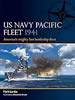


The United States Pacific Fleet was formed as a result of the rise of Nazi Germany, and the resulting possibility that the US might have to fight two different naval wars in different oceans at the same time. The ships that filled it were mostly designed and built under the terms of the inter-war naval treaties,
After a look at this historical background we move on to look at the ships themselves. During the attack on Pearl Harbor that fleet contained 108 major warships, 22 auxiliary warships and 55 auxiliaries, so there isn’t space here for a detailed examination of all of these types. We start with the battleships. When the Pacific Fleet was created it had the twelve most modern battleships in US service, but the three New Mexico class ships moved to the Atlantic in 1941. These were all ‘standard type’ battleships, commissioned between 1916-23, heavily armed and armoured, but slow compared to their potential Japanese opponents (and too slow to effective escort aircraft carriers). This does mean we get a decent amount of info on them, as each new class was a development of the previous one.
Next come the aircraft carriers – starting with the early conversions of Lexington and Saratoga, and moving on to the Yorktown class. There is also a quick look at carrier doctrine of 1941, which saw each carrier used independently, rather than in massed carrier groups as quickly became the standard during the Pacific War.
The section on cruisers looks at the old scoutn cruisers, and the treaty limited light and heavy cruisers (separated by their gun size rather than displacement or armour). By 1941 these ships were expected to act as independent raiders or support the battle line, and to a lesser extent as anti-aircraft ships (although 1941 anti-aircraft armament would soon prove to be inadequate).
The US Navy had spent most of the inter-war period relying on the First World War flush-deck destroyers built in vast numbers, but by 1941 the Pacific Fleet had almost entirely moved to the newer 1930s types. These would be the types that fought in the early battles of the Pacific War, before wartime construction began to take over. These destroyers were designed for fleet work – heavy torpedo armament, good guns, but little or no anti-submarine capabilities.
The US submarines were intended to work with the main fleet, serving as scouts for the Battle Force, rather than as long range raiders.
The biggest section looks at the auxiliary ships, simply because there were so many types of them. Here we see how the US Navy was planning for a war in the Pacific, with fleet oilers capable of refuelling warships at sea, supply ships, minesweepers and minelayers, transport ships, ammo ships, destroyer, submarine and seaplane tenders.
We then move on to a look at technical factors – surface combat guns, torpedoes, anti-aircraft guns, radar, aircraft and men.
An interesting point made about the guns is that they were designed for a type of battle they didn’t actual fight – long range daytime gunnery duels. Instead they were used in nightime battles, normally at short range, especially before radar gunnery came in from 1943. The torpedoes were famously dreadful in 1941 – unreliable, running deeper than expected, with magnetic detonators that didn’t work, a contact exploder that could fail if it hit dead on, with lighter warheads, shorter range and slow top speeds than other nation’s torpedoes. The anti-aircraft guns were variable – the best of the heavy types, the 5in guns, were very good, the lighter guns inadequate. Doctrine was good, but the number of guns needed improvement. The carrier aircraft are familiar types, although it is interesting to learn that the peacetime carriers carried as many as 20 utility aircraft in their air groups – something that changed very quickly once the fighting started!
We get a good section on the men of the US Navy. The peacetime navy had been able to select a high quality of recruit, and even the 1940-41 expansion was still limited to volunteers. Officer training began to expand in scale as early as 1935 with the Reserve Officer Training Corps, and this helped ensure the massive flow of new officers needed in the wartime navy.
Doctrine and Command looks at how this powerful fleet was organised and commanded, the split into Battle Force, Scouting Force, Base Force and Amphibious Force, what each of these forces contained and what it was meant to do. The Battle Force was still seen as the main fighting force, and the aim of the doctrine was to engineer a way to get the US battleships into a clash with any opposing battleline in as advantageous a way as possible. This is not so different from the Japanese desire for the ‘decisive battle’, although each expected to be able to lure the other into waters of their choice. Neither side was to get the battle they had expected. However as the author points out, the US Pacific Fleet didn’t have much choice – it only had three aircraft carriers, compared to nine battleships in December 1941.
The combat section inevitably focuses on the attack on Pearl Harbor. This demonstrates that it was the surprise of the attack that did the damage, with the worst of the damage done in the first fifteen minutes of the attack, before the Pacific Fleet was firing back. The first Japanese wave escaped with minimal loses, the second wave suffered more significant loses. However it was the Pacific Fleet that really suffered.
After this the only significant operation was the failed attempt to save Wake Island, which suffered from a slow start, operational confusion, and the change of Pacific Fleet commander from Admiral Kimmel to the cautious Admiral Pye. Nimitz officially took over commander on 31 December 1941, a fitting date to mark the change in fortunes of the US Pacific Fleet.
Chapters
The Fleet’s Purpose
Fleet Fighting Power
How the Fleet Operated
Combat and Analysis
Further Reading
Author: Mark Lardas
Edition: Paperback
Pages: 82
Publisher: Osprey
Year: 2024