 |
|
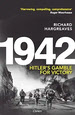


1942 was the last year in which Germany had a realistic chance of winning the Second World War (or at least of forcing her enemies to accept a peace deal). The German plan for the year involved two separate offensives. The most important was on the southern flank of the Eastern Front, where they intended to reach the Volga, and turn south to conquer the Caucasus, and thus cut off the Soviet Union’s main supply of oil. The second was Rommel’s offensive in North Africa, which aimed at reaching the Nile and the Suez Canal, thus destroying the British position in North Africa and most of the Middle East.
In both campaigns the Germans started 1942 with much work to do before they could focus on their main objective. On the Eastern Front the last parts of the Crimea needed to be conquered as did the start points for a potential advance towards the Volga. In North Africa Rommel began 1942 at El Aghelia, at the western end of Cyrenaica, having been forced back from Tobruk at the eastern end late in 1941.
In both cases there were delays before the main offensive could begin. On the Eastern Front the prolonged siege of Sevastopol lasted into the summer of 1942, and the main offensive didn’t start until June. However the Soviets were convinced the main German offensive would be towards Moscow, so the German attack in the south caught the high command out. The Germans rapidly reached the Don and began to advance south-east down the river to the Don bend, where it was closest to Stalingrad. We then see Hitler making a major strategic mistake – splitting Army Group South into two. Both were to cross the Don, with Army Group A sent south into the Causcasus and Army Group B east towards Stalingrad.
In North Africa the year began with a German offensive that pushed the Allies back to the Gazala Line, west of Tobruk, but the fighting then settled into a stalemate for several months. However when Rommel did go onto the offensive, in June 1942, he won a series of startling victories. The Allies were forced out of the strong but poorly designed Gazala line, missing a chance to inflict a heavy defeat on Rommel’s armour when it was trapped on the wrong side of the intact line. Tobruk fell, followed by Mersa Matruh in Egypt. The Axis advance was finally stopped at El Alamein, only 60 miles west of Alexandria.
This is the point at which the tone of the book changes. Until this point we have largely seen succesful German advances and Allied retreats and defeats. However the Germans were increasingly thinly stretched and operating at the far end of their supply lines. At Stalingrad we see the Germans slowly grind their way into the city, eventually occupying 90% of the urban area, but never entirely pushing the Soviets out of the city. In the Caucasus the Germans captured Maikop, on the northern side of the Caucasus Mountains, but were unable to cross the mountains to threaten Baku or to push east to Grozny. In North Africa the El Alamein position couldn’t be outflanked, because it ended at the Qattara Depression, lined by massive escarpments that stopped vehicle movements, and covered in salt flats and salt marshes, making it unsuitable for armoured warfare. As a result Rommel’s only choice was to batter his way through the Allied lines, but his two attempts to do this both ended in costly failure.
Finaly we move onto the Allied counterattacks. In both cases these destroyed the German position on those fronts. Operation Uranus saw Soviet forces attack the weakly held German lines on either side of Stalingrad, trapping the Sixth Army. Further Soviet offensives threatened to cut off Army Group A, which was forced to retreat out of the Caucasus. In North Africa Montgomery’s long planned counter-blow at El Alamein shattered the Axis position in Egypt and forced Rommel into a retreat that didn’t end until he had reached Tunisia!
We get a lot of eyewitness accounts from the German side, starting with an account from the troops who got furthest to the east, a reconnaissance force that almost reached Astrakhan, at the mouth of the Volga, well in advance of the main German forces. This makes the book very atmospheric, and gives us a clear idea of how the Germans and their allies were operating at the very extreme end of their supply chains, in entirely unfamiliar environments. We also get good Soviet accounts of the fighting at Stalingrad, to emphasis that the suffering was on both sides. There is also a good chapter on the experiences of the Hungarian, Romanian and Italian armies on the Eastern Front (one notable feature is that the Romanians and Hungarians each expected to be fighting the other sooner or later, and tended to see the fighting in the Soviet Union as a bit of a distraction!).
This is an excellent study of the key year of the war against Germany – the last year in which the Germans were able to carry out large scale offensives that gave them the initiative for much of the summer, and in the year in which they suffered the major defeats that put them onto the back foot, leading to two and half years in which they were almost always on the defensive, slowly being pushed out of the areas they had conquered earlier in the war.
Chapters
1 – Unfinished Business
2 – Rommeling Again
3 – Victories Without Victory
4 – Tomorrow We’ll Be Drinking Coffee in Cairo
5 – Three Axis Armies on the Don
6 – We’re Holding on to What We’ve Got
7 – We Have Just Taken on Too Much
8 – Endgame, not Endsieg
Author: Richard Hargreaves
Edition: Hardcover
Pages: 496
Publisher: Osprey
Year: 2026