 |
|
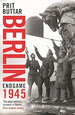


This is the last entry in Buttar’s excellent series on the Eastern Front, and covers the final battles in Germany – in particular the battles on the approaches to Berlin and the fighting in the city itself. The nature of this fighting is different to that in any other book in the series. The German armed forces were effectively disintegrating during these battles. On Hitler’s map there were still armys, corps and divisions, giving the illusion of an organised last stand, but on the ground most of the units were massively under strength if they existed at all, communications between them were poor or non-existent, and as the fighting continued the gap between the orders being used to these units and what they were able or willing to do grew increasingly wide.
At the very start of the narrative there were still some coherent German defences. The fighting on the Seelow Heights was especially difficult for the Soviets, with the Germans able to take advantage of a very strong physical position, on hills overlooking the Soviet line of approach, but also aided by Zuhkov’s rather unimaginative plans of attack. However even this stand only lasted for a couple of days. However the Germans couldn’t expect reinforcements or resupply, so their resistance was inevitably going to end in defeat. Elsewhere we see the Soviets making quicker progress, with Zhukov and Konev competing to the first one to reach Berlin, and Konev making more rapid progress at first.
One noteworthy feature of this battle is how short it was compared to many of the other major urban battles of the Second World War. From the start of the Soviet offensive on 16 April to the surrender of most troops in Berlin on 2 May was only just over two weeks. The first half of that saw most of the fighting take place outside the city. The actual urban battle lasted just over a week. There are several reasons for this, the most obvious being that the German military machine was falling part, so there were no reinforcements coming, no supply chains to keep the defenders fighting. Instead, once a unit had run out of its initial supplies of ammo it was largely on its own. Second, the Germans were massively outnumbered by this stage of the war – as the author points out, earlier in the war the Germans were able to assume that a German unit could cope with the next size of of Soviet unit – Divisions could defeat Corps, Corps could defeat Armies. By this battle that was no longer the case, and to make things worst often German units were facing a Soviet unit two sizes larger – Divisions facing Armies, Corps facing Fronts (army groups). The author also picks out a third reason – as the Soviets fought their way towards Berlin, the Germans sent most of their troops out of the city to try and slow the Soviet advance. As a result Berlin was left relatively lightly defended. The defence was also badly organised, with repeated changes of commander, overlapping zones of authority, rivalry between the army and SS etc. On a broader scale, Hitler’s refusal to allow his troops to withdraw meant that many were trapped against the Baltic coast, or sitting idle in Norway, unable to effectively contribute to this final battle.
The final chapters reflect the total defeat of Nazi Germany. The military story is joined by the political collapse – the last almost insane days in the Fuhrer Bunker, where its occupants lost grip with reality, fighting for scraps of power in a regime that clearly only had days to live. The surviving fragments of the German military switch their efforts from attempts to stop to Soviets to attempts to escape them.
Perhaps in acknowledgement that this book covers a much shorter period and smaller battle than earlier entries in the series, we start with a history of Berlin, its role in Nazi Germany, and the impact of earlier air attacks on the city, before we move onto the German plans to defend the area, and the Soviet plans of attack. The Soviet plans were motived by a desire to capture the city as quickly as possible, to make sure that it didn’t fall to the Americans instead (although the Americans had no intention of passing the Elbe and suffering casualties just to capture an area that was already known to be in the Soviet zone of occupation. There are also thoughtful sections on the Soviet atrocities that followed their occupation of German areas, and on reason many German troops fought on despite there being no chance of victory.
This is an excellent conclusion to this very impressive series, covering a wide range of topics related to the final fall of Nazi Germany and the events around it.
Chapters
1 – The City on the Spree
2 – ‘Call Me Meier’
3 – Preparing for the Last Stand: The German Defences
4 – The Red Army: Plans for Vengeance
5 – The Storm Bursts: 16 April
6 – Breakthrough: 17-18 April
7 – To the Gates of Berlin: 19-20 April
8 – Der Kreig is verloren: 21-22 April
9 – Into the City: 23-25 April
10 – Disintegration: 26-28 April
11 – The Bitterest of Ends: Berlin, 29 April-2 May
12 – The Roads to the West: 29 April-8 May
13 – Conclusion: An Uneasy Silence
Author: Prit Buttar
Edition: Hardcover
Pages: 448
Publisher: Osprey
Year: 2026