 |
|
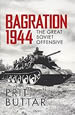


Operation Bagration was probably the most succesful Soviet offensive of the Second World War. It saw the destruction of the German Army Group Centre and the liberation of Belorussia and the Soviets start to advance beyond their original western border of 1941, entering Poland and ending the campaign on the outskirts of Warsaw. It took part at the same time as Operation Overlord, and between them the two campaigns effectively ended any German chance of stringing the war out too long into 1945.
At the start of the offensive it was already very likely that the Soviets would win a significant victory. They outnumbered the Germans in the centre of the line, the Germans were convinced the main Soviet attack would come further south on the front, the certainty that the Western Allies were about to invade France meant that no major reinforcements would be available, and the German troops manning the line were in pretty poor shape. The Soviets had planned very carefully for this offensive, and had learnt many lessons from earlier attacks.
However it also quickly becomes clear that the scale of the Soviet victory was greatly aided by the dysfunctional German high command, and in particular by Hitler’s unwillingness to allow beleaguered troops to retreat when it would have done some good. Even before the Soviet attack began, Hitler refused to let his troops retreat from the Vitebsk salient, leading to one of the early disasters of Bagration. In addition he declared a large number of locations to be fortresses, to be held at all costs by their garrisons. His idea was that this would force the Soviets to leave even larger number of troops behind to besiege these places, but the Soviets had learnt not to do that, and instead just screened them until second echelon troops could come up to deal with the siege. As the Soviet offensive rolled on, we repeatedly see the same pattern – German units are dangerously isolated, their commanders ask for permission to withdraw largely intact, Hitler refuses until it is too late, and the unit suffers heavy, irreplaceable losses trying to break out. Hitler’s one accurate contribution to the year’s campaign was his understanding that the only hope left was to defeat the Western allies when they invaded France, to allow German to concentrate most of their forces in the east.
Most of the campaign follows a similar pattern, with sizable Soviet offensives breaking through the German lines, then causing too much disruption for a new line to be formed. The lack of any reinforcements from the west meant that the majority of forces that could be found to plug gaps would have to come from elsewhere along the Eastern Front, and in particular the Ukrainean front to the south, leaving that area vulnerable as well. The crushing defeat of Army Group Centre also meant that Army Group North had to retreat rapidly back towards East Prussia in an attempt to avoid being cut off in the Baltic States – this ended in failure, with large parts of Army Group North stuck in the Courland pocket in Latvia
The conclusion brings up some interesting points. The biggest surprise to me was that the scale of the German defeats in the West and the East were actually quite similar, with the estimated casualty ranges very similar. The number of German troops committed on the German side was higher in the east, but not by as much as one might expect. The biggest difference was in Allied casualties, with the Soviets suffering three times as many losses as the Western Allies in campaigns that achieved similar victories. This says a lot about the brute force nature of the Soviet military, even after several years of improvement.
The author is a bit too sympathetic to the Soviet excuses for not helping the Warsaw uprising. It is true that their armies had fought many major battles, advanced for several hundred miles and were at the end of long supply lines. However they were close to Praga, the eastern suburbs of Warsaw, and the city itself was so close it was within artillery range! The argument that it would have required too long to prepare for a major river crossing into an enemy held city fails to take into account that large parts of the city weren’t enemy held for some time. The refusal to allow Allied aircraft to use Soviet bases to support the uprising is very telling. While the Red Army might not have been in a fit state to strongly support the uprising, it certainly could have done more than the nothing at all it did for most of its duration. The only significant attempt to help made by the Red Army was made by units from the Soviet’s own First Polish Army, and probably cost that Army’s commander his job.
This is an excellent study of one of the most significant Soviet offensives of the Second World War, and fills a gap in my knowledge – there is a tendancy to focus on the big urban battles – Stalingrad, Leningrad, Berlin – and skip over these bigger, more amorphous offensives, so it’s very encouraging that Buttar has filled that gap.
Chapters
1 – Fritz and Ivan: The State of the Armies of the Eastern Front
2 – The Front Behind the Front: Partisans in Belarus
3 – Preparing the Blow
4 – Waiting for the Hammer to Fall
5 – A Fateful Anniversary: 22-24 June
6 – The Floodgates Open: 25-28 June
7 – Exploitation: 29 June-3 July
8 – The Surge to the Frontier: 4-8 July
9 – Vilnius: 9-14 July
10 – Fire Brigades: The Panzer Divisions and the Red Army, 9-19 July
11 – Interlude: ‘Make Peace, You Fools!. What Else Can You Do?’
12 – High Tide for the Red Army
13 – Praga and Warsaw
14 – The Third Reich on the Brink
Author: Prit Buttar
Edition: Hardcover
Pages: 480
Publisher: Osprey
Year: 2025