 |
|



This is the third edition of a successful Second World War skirmish wargame, and the start of a sizable line of supporting books (eight army books at time of writing!). Warlord Games produces a series of 28mm figures to support the game, but there is no shortage of Second World War figures and vehicles in any number of scales.
Army building is fairly simple. Armies are built around platoons, each of which has a type and an order of battle that gives you a list of compulsory and optional squads. You have to start with a rifle platoon. Each rifle platoon you pick lets you pick one of each of every other type of platoon, so an army with only one rifle platoon can only have one heavy weapons platoon, artillery platoon, engineer platoon, armoured platoon and recce platoon. If you want a second armoured platoon then you have to pick a second rifle platoon. The general rules give orders of battle for each platoon type. A rifle platoon has to have one platoon commander and two infantry squads, and then add more infantry squads, a medic, forward observer, heavy weapons team, sniper team, anti-tank team, light mortar teams as well as one transport vehicle per unit in the platoon.
We then move to the individual army rules – here we get Germany, Japan, the Soviet Union, the USA and the United Kingdom. Each of these provides its own squads to fill these spaces. For the Germans we get a standard Heer infantry squad, a Kradschutzen motorbike squad (technically you don’t actually have to give them their bikes!), a grenadier squad, fallschirmjager (paratroopers), gebirgsjager (mountain troops), Waffen-SS squad, cavalry squad and inexperienced squad (Hitler Youth, volksturm etc) to fill the infantry squad slots. Each squad has its own equipment list and special rules – fanatic for the SS, fieldcraft for the mountain troops etc. These squads are the units used in the random activation phase, not the platoons. There are also expansion books that contain more detailed army lists.
The aim is to produce armies with a mix of troop types. The smallest possible rifle platoon will have one officer and ten men, so you’ll have to have that many infantry figures for each armoured platoon. Having said that an armoured platoon can contain from 2-5 vehicles, and an artillery platoon up to four guns and four transport vehicles, so you can still have very vehicle heavy armies. If you want more details, the Army books provide it – here we get one entry for the Sherman with a range of options, in the Army book we get six for gun armed versions and another five for special variants (flamethrower to bulldozer).
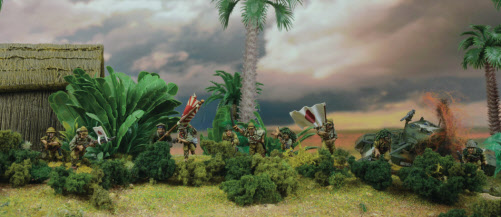 The rules suggest a 1,000pt game should be the standard. For our German army, a regular infantry squad starts at 50pts. That rises to 100pts for a full sized unit of ten, or a maximum of 149pts for a 10 man unit on bikes, with anti-tank grenades, one submachine gun and one light machine gun. A regular Panzer IV starts at 175pts or 225pts for the later anti-tank version. A single veteran Tiger II would cost you 528pts. A single maxed out rifle squad and four Panzer IVs would almost fill our 1,000pts, just leaving space for the other compulsory troops. The system does allow you to have a very varied force, but it’s firmly aimed at skirmish level battles. It is also worth noting that their example armies each come to around 1,250pts.
Vehicle rules reflect the historical situation quite nicely. In contrast to games that make every aspect of each vehicle highly individual, Bolt Action uses a number of generic building blocks as the basis of the vehicle system. Tanks come in light, medium, heavy and super-heavy, as do anti-tank guns. The basis stats for similar vehicles carrying similar guns will thus been the same. This rather fits the reality on the ground – although different nations produced different guns, the differences between the main types of 75mm guns were much smaller than the differences between the 75mm gun and smaller caliber guns. At this scale, they really aren’t significant. However that isn’t to say that every vehicle is the same – each one has a massive series of options to allow you to model particular variants, while each country has special rules. For the US we get gyrostabilisers that eliminate the ‘to hit’ penalty for firing while moving. There are plenty of special rules to provide flavour – early war British infantry tanks get slow, the Panther gets stronger front armour etc. This system means you can model an early Panzer IV with light howitzer or late war Panzer IV with heavy anti-tank gun without it getting too complex.
The turn sequence uses random activation. Each player needs a ‘order dice’ for each unit in the army with each side needing a different colour dice. These dice are all put in a bag, and then drawn out randomly. The play whose colour is drawn picks one of their units that hasn’t already gone, gives it an order, and then carries out that order – the dice is then left by the unit to mark what order it was given (a vehicle that was ordered to move at top speed can’t be assaulted by infantry etc). As you would expect there are six possible orders – Fire, Advance (move and fire), Run (move at double speed), Ambush (don’t fire now, but wait for the chance to do so), Rally (clears pin markers, the main measure of morale) or Down (no action but makes them harder to hit). Some rules over-rule the random draw – if a unit that hasn’t received an order yet is shot at it can choose to use its order to go ‘down’, and the correct dice has to be fished out of the bag.
There is the potential for a lucky player to get to go first with a large proportion of their army, but this isn’t terribly likely – the bigger the battle the less likely it is. The ability of the defending play to use some reactions mitigates this – as well as units being able to go ‘down’ if fired on, a unit that hasn’t been activated can fire on an unit that assaults it from more than 6in away.
Infantry vs infantry melee is always deadly – both sides fight simultaneously, and the one that causes the most damage is the winner (unless it is actually wiped out). The loser is destroyed, representing the survivors surrendering. Melee combat is nice and simple. Each side rolls 1D6 for each figure in the unit, with the target number decided by the skill of their opponents – 3+ for inexperienced up to 5+ for veteran. Some units have the Tough Fighters rule which allows them to re-roll failed damage rolls.
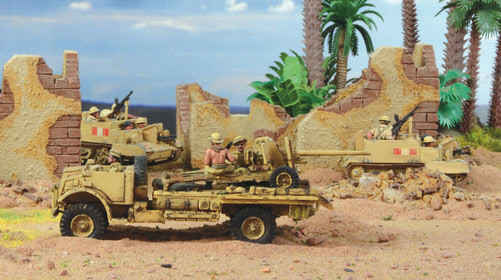 In action things can get pretty deadly – if your infantry gets caught in the open by other infantry it will probably suffer pretty heavy losses. Infantry vs armour battles depend on two factors – infantry without dedicated anti-tank weapons will do badly, and the size of the unit is absolutely key – you roll D6 for each figure in the attacking unit and score one hit for each roll of 4+ against a static vehicle or one that hasn’t yet been given an order that turn, add up all the hits and add another D6 to get your final attack value. This is compared to the vehicle’s damage score - 9+ for a Matilda Infantry Tank for example. A standard infantry section with anti-tank weapons starts at five men, so would need some very good rolls to damage a Matilda – three hits out of five and a 6 on the D6. In contrast a full squad of ten men would probably expect five hits and would need a 4 to do superficial damage. Vehicle vs vehicle combat uses damage tables. The attacker makes a damage roll – D6 plus the penetration value of their weapon plus any bonuses that apply (rear armour etc). Anti-tank guns range from +4 to +7. Armoured vehicles had a defence value ranging from 7 to 11. If the attack beats defence by 1 or 2 you roll once on the full damage table, by 3 or more you roll twice. This is a D6 table, with results ranging from crew stunned to knocked out – there is a 50/50 chance of a vehicle being directly knocked out, and one of the other result sets it on fire with the potential to be destroyed. The figures have been worked out nicely – a super-heavy anti-tank gun can do a maximum of 13 damage, so needs a roll of 5 to do full damage to a super-heavy tank, but can’t do massive damage to it.
I found this to be an entertaining game. The army building is fun, and even the standard army lists included here provide a lot of detail. The random activation system adds a unique touch to it, and the combat is generally quite simple. Although it’s designed for skirmish scale games, it scales up quite nicely (although the fairly deadly combat means most battles shrink pretty quickly!). The main rules contain everything you need to get gaming, a nice chance compared to those systems that require rule books and army books before you can get started. The extra army books give even more flavour to the rules, although aren’t essential.
Chapters
Basic Supplies
Conventions of War
Units
The Turn
Orders
Movement
Shooting
Weapons
Close Quarters
Headquarters
Unit Special Rules
Artillery
Vehicles
Buildings
Playing a Game of Bolt Action
Force Selection
The Army Lists
Timeline
Author:
Edition: Hardcover
Pages: 228
Publisher: Osprey Games
Year: 2016