 |
|
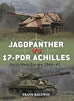


The introduction to this book acknowledges that the Jagdpanther and Achilles were very different weapons, and one of the aims of the author is to examine why the British and Germans produced such different weapons to fulfil a similar anti-tank role. It then goes on to look at the evolution of anti-tank weapons. This shows how different the evolution of self-propelled anti-tanks was on the two sides.
The Germans producing a series of similar vehicles, armoured boxes with the gun carried in the front of the hull, with limited range of movement but heavy armour – most famously the StuG, but this was only one of many. The Jagdpanther was thus a logical progression in this line of weapons.
On the British side most early self-propelled anti-tank weapons were pretty poor – 2-pdr or 6-pdr guns mounted on universal carriers or trucks, with very limited protection. The Achilles emerged from the American Tank Destroyer programme instead. This had evolved from American research into the German victory in France in 1940, and called for a concentration of very mobile, heavily armed ‘tank chasers’, that could react to a concentrated German armoured attack. We see how this led to the creation of the tank destroyer – fast, heavily armoured but generally poorly armoured vehicles, carrying their anti-tank gun in an open top turret. The Achilles took the American M10 tank destroyer and replaced its 3in gun with the excellent 17-pdr anti-tank gun.
The book follows the normal format in this series – Design and Development looks at what each weapon was and how it was developed, the Technical Specifications chapter looks at each element in turn, alternating between the two vehicles.
The Design and Development section for the Achilles starts with a look at the original M10, which was itself based on the chassis of the M4 Sherman. We then move on to the British search for a mount for the 17-pdr, which also produced the Archer and Avenger, although neither appeared early enough to be really significant. The Achilles was able to enter service much more quickly, because the M10 turned out to have been designed to take different guns, including the American’s own 76mm M1 gun. This meant that it was straightforward to install the 17-pdr, and over 1,000 Achilles were produced (although most were converted after D-Day).
On the German side the Jagdpanther was a modified version of the Panther, with some elements from the abandoned Panther II and an 88mm gun similar to that used on the Tiger II.
The technical specification section starts with a warning that the two vehicles were very different, so direct comparisons of most aspects isn’t that valuable. One area where this isn’t the case is the gun – both were designed as mounts for one of the best anti-tank guns available to their side. The 17-pdr was capable of penetrating the frontal armour of the Panther at the normal combat ranges found in Normandy. The German 88mm was more powerful, because it had been developed to deal with the very heavily armoured Soviet tanks. The Jagdpanther also had better fire control, with a stereoscopic rangefinder and a better gun sight.
Armour is the biggest difference – the Jagdpanther was very heavily armoured, designed to survive hits from enemy tanks, while the M10 had thinner armour than the original M4 Sherman, and its open turret was a big vulnerability.
The Achilles was the winner on mobility, with a better power-to-weight ration than the Jagdpanther. The Jagdpanther did have better tracks, allowing it to cross terrain that might have stopped the M10, but its interlocked road wheels could easily get clogged with mud, and any repairs to inner wheels or the suspension required the removal of four or five other wheels. We also get figures for their relative reliability, with the Achilles suffering a 1% breakdown rate on road marches, compared to 10-20% for the Jagdpanther (similar to the problems with the Panther itself).
The Combatants section includes some general training notes then moves onto the units involved in the combat section – the 6 Anti-Tank Regiment RCA and Schwere Panzerjager-Abteilung 655. It is clear here that the Germans had a much clearer idea of how they intended to use the Jagdpanther than the British did for the Achilles.
The combat section gives an overview of where the two vehicles were used during the Normandy campaign. The Achilles was widely used across the British and Canadian forces, the Jagdpanther only trickled into combat late in the battle. As the intro made clear, there weren’t many occasions when the two types of vehicles clashed directly. The direct clashes that are detailed came in the Reichswald in 1945. This was a very short engagement – a Jagdpanther fired towards the 2 Monmouthshires as they were passing through the Reichswald forest. The troop commander, Lt Kydd, scouted out the German position on foot, managed to get one Achilles into a firing position, and knocked out the Jagdpanther.
The conclusion makes some key points. The most important is that the Jagdpanther was never present in enough numbers to allow the use of proper doctrine. Instead of being used in large numbers, they were thrown in whenever available, allowing the more numerous Allied vehicles to overwhelm them.
This is an unusual entry in the versus series in that the two vehicles being studied hardly ever clashed – possibly just the couple of examples in the Reichswald. Instead it compares two very different vehicles designed to carry out the same basic task, but in rather different ways.
Chapters
Chronology
Design and Development
Technical Specifications
The Combatants
The Strategic Situation
Combat
Statistics and Analysis
Aftermath
Author: Frank Baldwin
Edition: Paperback
Pages: 80
Publisher: Osprey
Year: 2025